
Premium-To-Tax (Insurance Premium Tax Compliance Process)
Note on the demo: The dataset shown in this article is a synthetic demonstration dataset. It is intentionally not perfectly standardized: several realistic deviations have been introduced to illustrate typical process-mining questions around compliance, rework, missing process steps, incorrect sequencing and incomplete cases. The figures are not the production metrics of any customer.
When you describe tax compliance from a high level, the flow sounds simple: a premium is booked, the tax is determined and calculated, the return is prepared, approved, filed and paid.
In reality, an Insurance Premium Tax (IPT) process is considerably more complex. A single tax-relevant insurance transaction has to pass through operational insurance data, tax determination and calculation, accounting, reconciliation, tax-return preparation, approval, filing and payment before a case is truly complete. Each business object carries a created_at timestamp, and these timestamps are used to reconstruct the actual process flow.
It is precisely in such processes that the value of process mining becomes apparent: a single process map does not answer every business question, and the interesting insights lie less in the happy path than in the deviations from it.
The central question is therefore not only: How do we visualize the process?
But rather: How does the process actually run compared with the expected process – where do deviations occur, and which of them create compliance or operational risks?
1. The process objective: from premium transaction to tax payment
The purpose of the process is to ensure that insurance premium transactions are correctly identified as tax relevant, assigned to the correct tax jurisdiction, taxed using the appropriate tax rules, correctly calculated and posted to accounting, reconciled against financial records, included in the appropriate tax return, reviewed and approved, submitted to the relevant tax authority and finally settled by the corresponding tax payment.
The intended process follows a clear sequence:
Record premium transaction → Determine risk location → Conduct tax determination → Calculate tax amount → Post tax to general ledger → Reconcile tax amounts → Prepare tax return → Prepare tax return item → Review and approve tax return → File tax return → Execute tax payment
Each step is modeled as a sequential process slot with realistic waiting times between the individual activities. A successfully completed case therefore ends with the tax return having been both filed and paid.
2. The process steps in detail
The end-to-end flow is built from eleven core activities, each backed by its own source object.
Record premium transaction
Source table: PREMIUM_TRANSACTION. The process starts when an insurance premium transaction is created – for example a new premium, renewal, adjustment, cancellation or refund associated with a policy. It provides the financial basis for the subsequent tax determination and typically carries policy reference, premium amount, currency, transaction type, booking information and posting status. Typical duration to the next activity: approximately 4 hours.
Determine risk location
Source table: RISK_LOCATION. The location of the insured risk is determined. This is particularly important for insurance taxation, because the location of the risk can determine which country or jurisdiction has the right to levy IPT. Typical information includes country, region, risk type and validity period. Typical duration to the next activity: approximately 3 hours.
Conduct tax determination
Source table: TAX_DETERMINATION. Based on the premium transaction, the risk location and the applicable tax rules, the appropriate tax treatment is determined – tax type, tax jurisdiction, applicable tax code, applicable tax rate and determination status. The determination may reference centrally maintained rules from the TAX_RULE master-data table. Typical duration to the next activity: approximately 2 hours.
Calculate tax amount
Source table: TAX_CALCULATION. The actual tax liability is calculated using the determined treatment, containing taxable base, tax rate, calculated tax amount and calculation status. This creates the monetary tax value that will subsequently be posted and reconciled. Typical duration to the next activity: approximately 4 hours.
Post tax to general ledger
Source table: GL_POSTING. The financial transaction and related tax amount are posted to the general ledger, with GL account, company code, debit/credit indicator, posting amount, posting date and accounting document reference. The posting provides the financial record against which the tax calculation can subsequently be reconciled. Typical duration to the next activity: approximately 4 hours.
Reconcile tax amounts
Source table: TAX_RECONCILIATION. The calculated tax amount is compared with the corresponding accounting posting in order to identify discrepancies between the operational tax calculation and the financial records. Relevant information includes tax calculation, accounting posting, difference amount, reconciliation result and potentially an associated tax exception. Reconciliation is one of the most important control points in the overall process. Typical duration to the next activity: approximately 24 hours.
Prepare tax return and tax return item
Source tables: TAX_RETURN and TAX_RETURN_ITEM. Once the relevant transactions have been processed and reconciled, the tax return is prepared for the appropriate reporting period, grouping tax information by legal entity, tax type, jurisdiction, filing period, due date and total tax liability. Individual tax calculations are then assigned to the return as tax return items, creating the connection between transaction-level calculations and the aggregated return. Typical durations to the next activity: approximately 12 hours and approximately 36 hours respectively.
Review and approve tax return
Source table: TAX_APPROVAL. Before the return is submitted externally, it is reviewed and approved, potentially involving tax specialists, managers or other members of the tax organization. Typical information includes reviewer, approval level, approval status and the related tax return. This activity represents an important internal compliance control. Typical duration to the next activity: approximately 24 hours.
File tax return and execute tax payment
Source tables: TAX_FILING and TAX_PAYMENT. Following approval, the return is submitted to the responsible tax authority, with filing status, authority reference and confirmation information. The final step is settlement of the tax liability with payment amount, payment status, tax return reference and bank reference. Typical duration between filing and payment: approximately 48 hours.
A successfully completed case ends with the tax return having been both filed and paid. Everything in between is a control point that process mining can make visible.
3. Supporting data objects
In addition to the operational activities, the model contains supporting objects that provide context without necessarily representing mandatory steps in the happy path.
- POLICY represents the underlying insurance contract and links transactions and risk information to the insurance business.
- LEGAL_ENTITY identifies the reporting company or company code responsible for the transaction and tax return.
- TAX_RULE contains the tax rules used during determination, including jurisdiction, tax type, rate and rule version.
- USER_ORG represents employees, roles, teams and organizational information used for responsibilities, exception handling and approvals.
- TAX_EXCEPTION stores tax-processing exceptions and can be associated with incorrect calculations, reconciliation differences or missing information.
These objects enrich the analysis by making it possible to ask not only what happened, but who was involved, which rule applied and which exception was raised.
4. Process problems and deviations
The core of the use case is the deliberate introduction of process deviations. These allow process mining to identify meaningful compliance and efficiency problems rather than showing a perfectly standardized process. Six particularly relevant problems have been included in the dataset.
Problem 1 – Risk location determination is skipped
Deviation type: overjump · Probability: approximately 5%
Expected: Premium Transaction → Risk Location → Tax Determination. Problematic: Premium Transaction → Tax Determination. In these cases the risk-location activity is skipped and the process proceeds directly to tax determination.
Why this is problematic: for IPT, the location of the insured risk can be critical for identifying the correct tax jurisdiction. Skipping this step could result in an incorrect tax jurisdiction, incorrect tax rate, incorrect tax treatment or insufficient evidence supporting the tax decision.
Process-mining question: How many transactions receive a tax determination without a preceding risk-location determination?
Problem 2 – Tax return is filed before approval
Deviation type: wrong order · Probability: approximately 3%
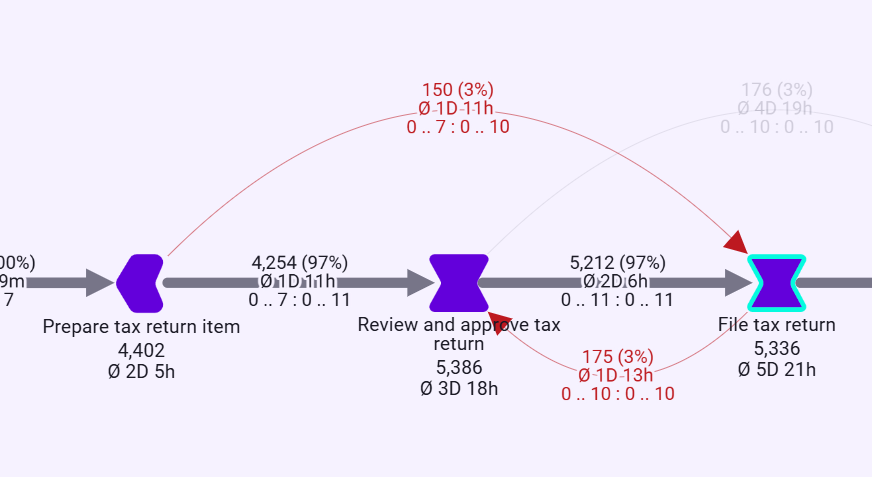
Screenshot – Problem 2: filing occurs before the required approval
Expected: Review and Approve Tax Return → File Tax Return. Problematic: File Tax Return → Review and Approve Tax Return. The required activities still take place, but in the wrong sequence.
Why this is problematic: the approval activity is an important internal control. Filing before approval means information may be submitted externally before the required review has been completed, with potential consequences such as unauthorized filings, inaccurate returns, internal-control violations, additional corrections and compliance findings.
Process-mining question: How often are tax returns submitted before formal approval? This shows why checking merely whether activities occurred is insufficient – the order of execution also matters.
Problem 3 – Tax calculation has to be reworked after reconciliation
Deviation type: rework · Probability: approximately 2%
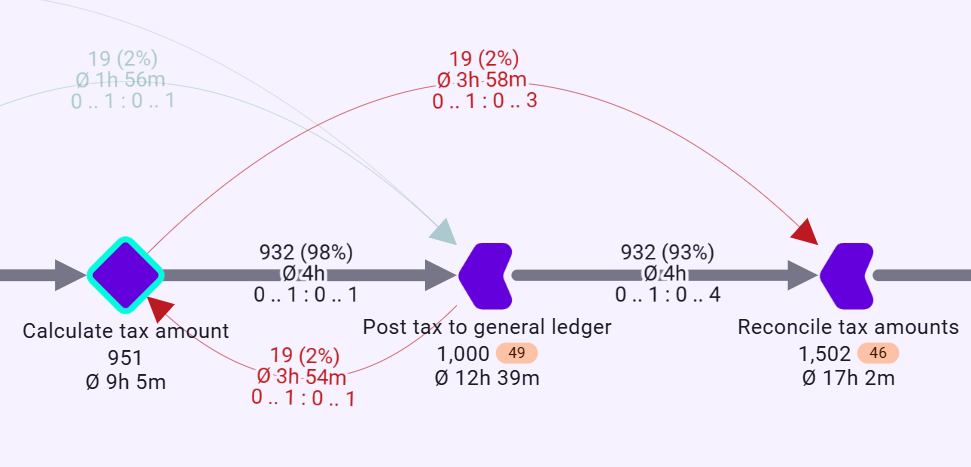
Screenshot – Problem 3: reconciliation triggers a repeated tax calculation
Expected: Tax Calculation → GL Posting → Reconciliation → Tax Return. Problematic: Tax Calculation → GL Posting → Reconciliation → Tax Calculation → …. The reconciliation identifies a problem that causes the tax calculation to be executed again.
Possible causes: incorrect tax rate, incorrect taxable base, wrong tax jurisdiction, a difference between tax calculation and GL posting, an outdated tax rule or incomplete source information.
Why this is interesting: this is likely one of the most important operational inefficiencies in the process, because it creates additional processing time, manual investigation, repeated calculations, additional accounting work and potentially delayed filing.
Process-mining questions: How often are tax calculations repeated? Which jurisdictions or tax types create the most calculation rework? How much additional processing time is caused by reconciliation failures?
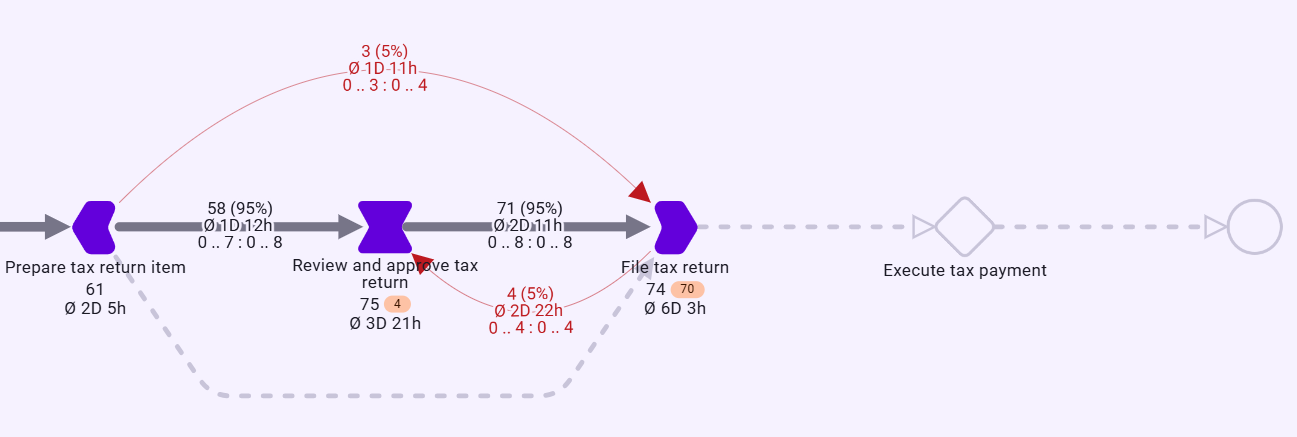
Problem 4 – Tax return items have to be reworked during approval
Deviation type: rework · Probability: approximately 5%
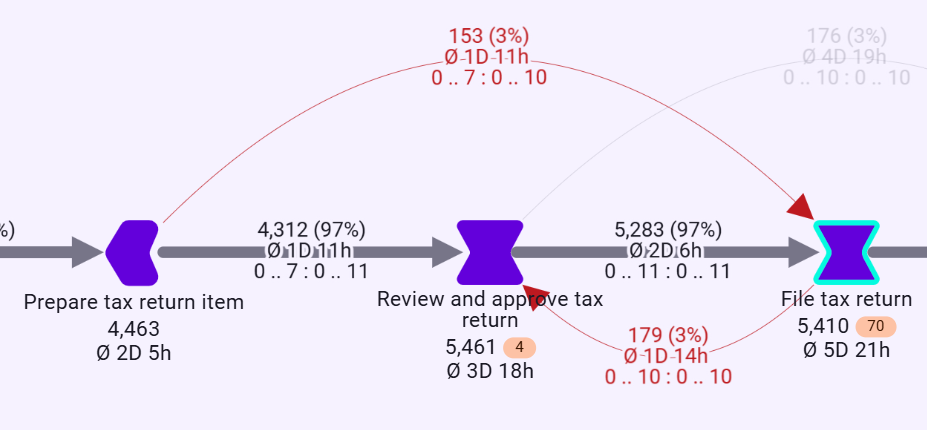
Screenshot – Problem 4: the return is sent back for correction during approval
Expected: Prepare Tax Return Item → Review and Approve Tax Return → Filing. Problematic: Prepare Tax Return Item → Approval → Prepare Tax Return Item → Approval. During the review, the reviewer identifies an issue with the content of the return and sends the process back for correction.
Possible causes: missing transactions, incorrectly included transactions, incorrect tax amounts, incorrect reporting period, incorrect jurisdiction or incomplete supporting documentation.
Why this is problematic: late rework is generally more expensive than identifying an issue earlier, and it can push the process closer to the statutory filing deadline.
Process-mining questions: How often are tax returns sent back during approval? Which teams or jurisdictions create the highest approval-rework rates? How much additional lead time does approval rework create?
Problem 5 – Process stops after reconciliation
Deviation type: abort · Probability: approximately 2%
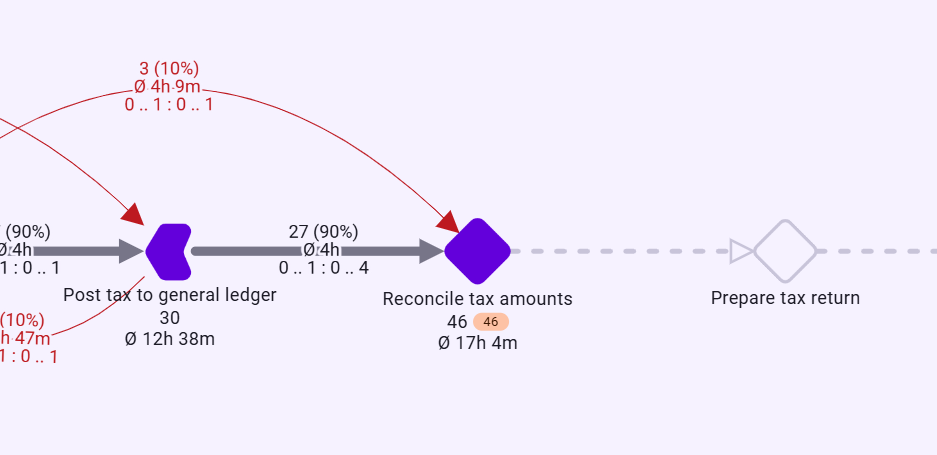
Screenshot – Problem 5: a reconciled transaction never reaches tax-return preparation
Expected: Reconciliation → Tax Return → … → Payment. Problematic: Reconciliation → END. The transaction is processed and reconciled, but no tax return is subsequently created.
Why this is problematic: such a transaction can effectively become lost between operational tax processing and tax reporting, with possible consequences such as unreported taxable transactions, incomplete returns, understated tax liabilities, missed filing obligations and compliance exposure.
Process-mining question: Which successfully reconciled transactions never reach tax-return preparation? This is an example of an incomplete process case.
Problem 6 – Tax return is filed but no payment is made
Deviation type: abort · Probability: approximately 2%
Screenshot – Problem 6: filing occurs but the payment is never executed
Expected: Approval → Filing → Payment. Problematic: Approval → Filing → END. The return has been submitted to the authority, but the process ends before the corresponding payment is executed.
Why this is problematic: this is a particularly important compliance risk, because the filing obligation may have been fulfilled while the financial obligation remains outstanding – leading to overdue tax liabilities, interest charges, penalties, payment reminders and additional manual investigation.
Process-mining question: Which filed tax returns do not have a corresponding tax payment? This creates a very clear control around filed-but-unpaid tax returns.
5. Key process-mining questions
The resulting dataset allows the analysis to move beyond simply visualizing the happy path. Important questions include:
- What percentage of cases follow the expected process, and which variants occur most frequently?
- Where are mandatory activities skipped, and which activities occur in the wrong order?
- How often does rework occur, and how much additional lead time does it create?
- Where do cases terminate prematurely?
- Which jurisdictions, legal entities, transaction types or tax types have the highest deviation rates?
- Which cases were filed without prior approval, and which filed returns have not been paid?
- Which transactions reached tax determination without a documented risk-location determination?
- Where are the largest reconciliation differences, and which parts of the process create the longest waiting times?
Conclusion: from "was it filed?" to "how did we get there?"
The main story of the use case is not simply that an insurer calculates and pays taxes. The process starts with a high volume of individual insurance transactions, each of which must be correctly classified, taxed, posted and reconciled before it can contribute to a tax return.
While the majority of cases follow the expected process, a smaller number contain meaningful deviations. Some transactions skip required control activities. Some activities occur in the wrong sequence. Some cases require rework because an earlier result was incorrect. Others stop before the tax reporting process has been completed.
Process mining makes these deviations visible and quantifiable. Instead of only asking whether a return was eventually submitted, the analysis can determine how the organization arrived there, which controls were followed, where additional work was required and where potentially risky process behavior occurred.
The use case therefore demonstrates three major areas of process-mining value:
- Compliance: identifying skipped controls, incorrect sequencing, missing approvals and incomplete tax obligations.
- Efficiency: identifying rework loops, bottlenecks, unnecessary repetitions and long waiting times.
- Transparency: connecting transaction-level tax processing, accounting, tax reporting, approval, filing and payment into one end-to-end view.
Transparency alone is not the goal. The value lies in understanding which controls held, where work had to be repeated, and where a tax obligation was left incomplete – and then acting on it.