Process Pattern Types
Allowed pattern types
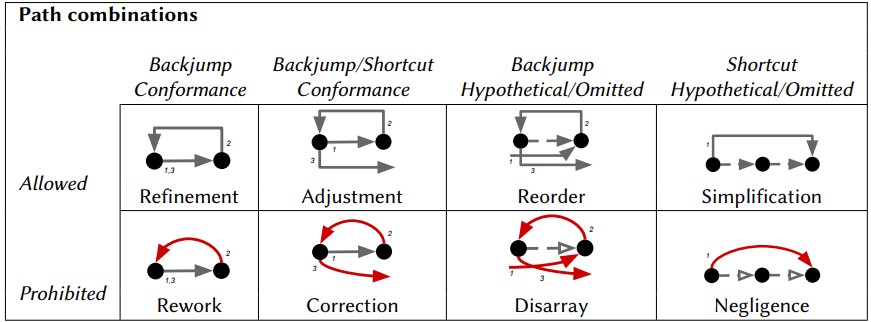
The allowed pattern types comprise path combinations, which are allowed by design. These include: refinement, adjustment, reorder, and simplification. Refinement is characterized by a backjump path that follows and is followed by two identical conformance paths leading to the emerging sequence ⟨𝑎1→C 𝑎2 → B 𝑎1 → 𝑎2⟩. Since the same directly follows relations 𝑎1→C 𝑎2 is executed twice, this pattern indicates a revising behavior (e.g., when a customer proofreads an order detail before purchase). Adjustment is characterized by a conformance path followed by a backjump path, which sequentially is followed by a shortcut path, leading to the emerging sequence: ⟨𝑎1→C 𝑎2 → B 𝑎1 → S 𝑎3⟩. Here, only the first activity 𝑎1 is executed twice (cf., refinement), thus indicating a re-routing of an intended activity sequence (e.g., when a customer cancels a requested credit card payment and, instead, decides to pay in installments). Reorder is characterized by a backjump path that follows a hypothetical path, which sequentially is followed by a shortcut path leading to the emerging sequence: ⟨𝑎1→H 𝑎2 → B 𝑎1 → S 𝑎3⟩. This means that the intended activity sequence is executed in reverse (e.g., when an order foresees a purchase-for-delivery procedure when, in fact, customers purchase items (through bill) after delivery). Simplification is characterized by a shortcut path that skips a sequence of hypothetical paths, such that the following pattern occurs: ⟨𝑎1(→H ... → H 𝑎n, → S 𝑎n+1)⟩ This pattern suggests redundancies in the process design (e.g., when customers use an autofill function to fill out their demographic details before purchase).
Prohibited pattern types
The prohibited pattern types are analogous to the allowed patterns but contain at least one prohibited path, thus indicating violations of an intended process design. These include: rework, correction, disarray, and negligence. Rework is the analog to refinement yet with prohibited paths, such that the following pattern emerges: ⟨𝑎1→C 𝑎2 ↛ B 𝑎1 → C 𝑎2⟩. Here, a refining behavior is instead a source of frustration or an unnecessary emendation (e.g., when a customer has to re-purchase an order after discovering the purchase of the wrong items). Correction is the analog to adjustment yet with prohibited paths, such that the following pattern emerges: ⟨𝑎1→C 𝑎2 ↛ B 𝑎1 ↛ S 𝑎3⟩. In comparison, whereas an adjustment may improve a process towards a better outcome, in correction, an avoidable mistake is adjusted to prevent harm (e.g., when a customer must be contacted after they were able to purchase an order with a suspended credit card successfully). Disarray is the analog to reorder yet with prohibited paths, such that the following pattern emerges: ⟨𝑎1→O 𝑎2 ↛ B 𝑎1 ↛ S 𝑎3⟩. Here, a rearrangement of (strict) protocol procedure is executed (e.g., when an order is marked as successful before verification). Negligence is the analog to simplification yet with prohibited paths, such that the following pattern emerges: ⟨𝑎1(→O ... → O 𝑎n ↛ S 𝑎n+1⟩. Here, the complete skipping of an intended activity sequence is considered wrong rather than as an improvement (e.g., when a customer is warranted a replacement item after a filed complaint without the warranty not being properly inspected by the company).
Use Cases for Pattern Types
Allowed patterns reflect expected behavior and give insights into how well a process is adopted. Prohibited patterns are more complex. In this section, we focus on prohibited pattern types as we expect more business value from their analysis. Therefore, we articulate three assumptions and review the pattern according to four performance dimensions relevant to business processes. In the second part of this section, we examine what a technical solution can look like and explain the business impacts that can be derived. We then further apply heuristics to improve the process. We measure the outcomes by the four performance dimensions of the devil’s quadrangle, namely, (1) time, (2) cost, (3) quality, and (4) flexibility. We apply this to emphasize that the improvement of one or multiple perspectives results in less performance of at least one other perspective. Therefore, we review only the prohibited pattern types and the impact on the four performance dimensions with three assumptions:
- With increasing complexity due to path variants and activity numbers, the average process instance duration increases
- Every activity has a cost, mainly labor costs, resulting in a negative financial impact per executed activity.
- Every activity adds value and, therefore, enhances the quality of the process outcome, resulting in better quality the more (planned) activities are performed.
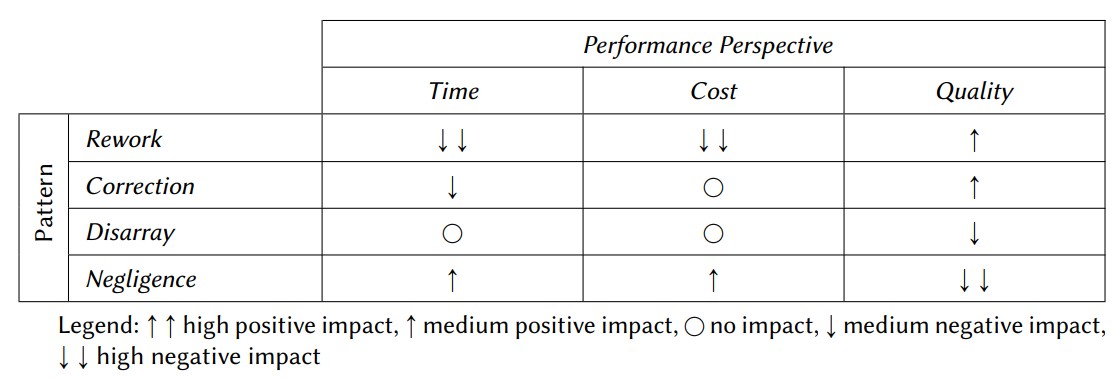
Based on these assumptions, the impact on process performance is summarized in table below.
- The rework pattern repeats two events and adds two connections, resulting in a high negative impact on cost. The quality is benefiting from the rework, as it repairs an error.
- The correction pattern repeats one event and adds one additional connection, resulting in a medium negative impact on time and costs. The quality is benefiting as an unexpected result is prohibited.
- The disarray pattern impacts time and cost under respecting the assumption, but a medium negative impact on quality as the sequence of events is not followed.
- The negligence pattern is skipping one event and having one connection less, resulting in a positive effect on costs and time. On the other hand, as an event is skipped, a high negative effect on quality is expected.