
Tutorial P2P - Loss of Discount - Working Capital
TL;DR
Goal: Deliberately delay payments and thereby generate cases in which an existing cash-discount deadline is exceeded.
Prerequisites: Invoice, invoice approval and payment are part of theCausal Chain.
Result: Certain invoices are deliberately processed later, so that their payment can fall afterskonto_frist_am.
The business question
Companies sometimes try to execute payments as late as possible in order to keep liquidity within the company for longer.
From a working-capital perspective, this can initially seem sensible.
At the same time, however, a conflict of objectives arises:
What happens when a deliberately delayed payment causes an existing cash-discount deadline to be missed?
For our synthetic use case, we therefore generate a relationship between:
pruefer_team
→ longer processing time
→ later payment
→ possible exceeding of the cash-discount deadline.
Desired data picture
The invoice already contains a fixed:
skonto_frist_am
In our model, this lies 14 days after the invoice was recorded.
A normal case can look like this, for example:
Rechnung
→ Rechnungsfreigabe
→ Zahlung
→ payment takes place before skonto_frist_am
With deliberately delayed processing, by contrast, the following should arise:
Rechnung
→ additional waiting time
→ Rechnungsfreigabe
→ Zahlung
→ payment lies after skonto_frist_am
1. Using a Conditional Rule
For this use case we do not need a new Special Behaviour.
Instead, we again change the process time.
Open: 04 Special Behaviour
and go to: Conditional rules (A / C / D)
Choose:
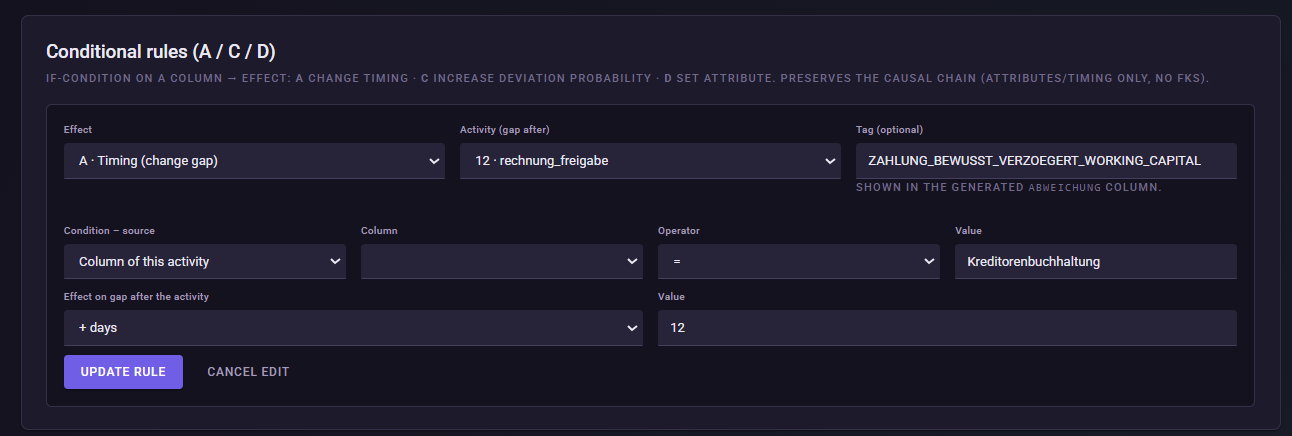
Effect: A · Timing (change gap)
This lets us extend an existing time gap depending on a business attribute.
2. Selecting the invoice as the starting point
As the:
Activity (gap after)
we choose: rechnung
The additional waiting time is thereby built into the process after the invoice.
At this point, the existing P2P process already has a normal processing time. For the affected cases, we now deliberately increase it.
3. Setting the condition on the checker team
Choose:
Condition – source: Column of this activity
Column: pruefer_team
Operator: =
Value: Kreditorenbuchhaltung
This links the delay to a concrete business attribute.
The statement reads:
If the invoice is processed by the team
Kreditorenbuchhaltung, the subsequent process time should be extended.
4. Generating twelve days of additional waiting time
Under:
Effect on gap after the activity
choose:
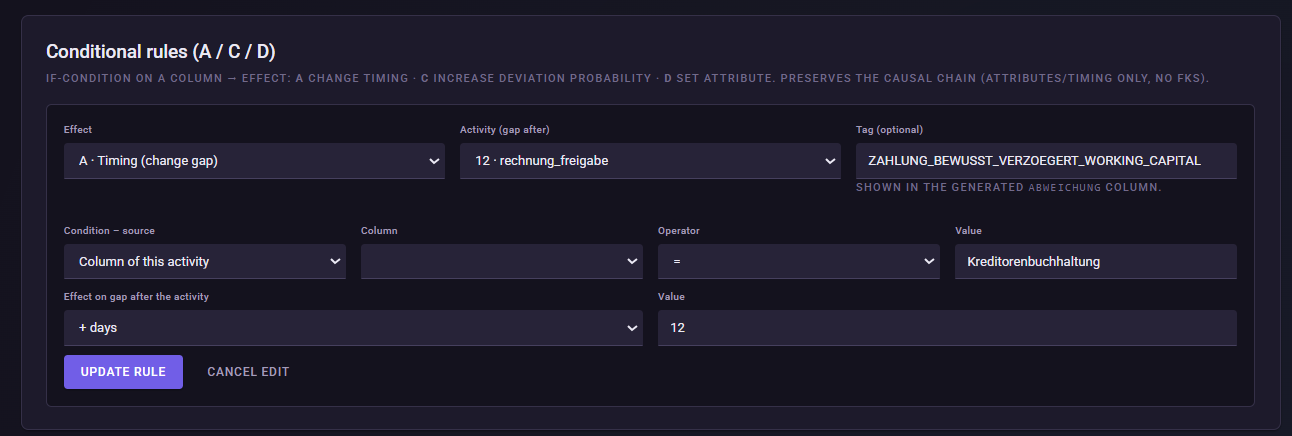
+ days
and enter:
12
This adds 12 additional days to the affected cases.
The basic principle corresponds to the existing P2P demo rule for working capital: there, too, twelve additional days are generated for invoices from the Kreditorenbuchhaltung team.
Set as the:
Tag:
ZAHLUNG_BEWUSST_VERZOEGERT_WORKING_CAPITAL
Why exactly twelve days?
In our data model, the invoice has:
skonto_frist_am
with a fixed distance of 14 days from the invoice recording.
At the same time, the normal process between invoice and payment already needs several days.
If we additionally build in:
+12 Tage
many of these cases will exceed the cash-discount deadline.
This produces a deliberately generated conflict of objectives:
keeping liquidity for longer
against
losing a possible cash-discount advantage.
A fixed deadline instead of a deadline shifted along
The important point here is:
skonto_frist_am
is a deadline.
The deadline should not automatically shift back just because the internal process takes longer.
Otherwise the additional delay would not produce any economic effect.
The desired pattern is therefore:
skonto_frist_am remains unchanged
while:
zahlung_ausgefuehrt_am
moves back.
This later allows checking:
zahlung_ausgefuehrt_am > skonto_frist_am
What do we model in the Simple training?
In the Simple model, we first generate the causal time conflict:
Kreditorenbuchhaltung
→ additional 12 days
→ later payment
→ cash-discount deadline possibly exceeded.
For this, the tables already contain the relevant fields:
rechnung.skonto_frist_am
rechnung.skonto_prozent
zahlung.zahlung_ausgefuehrt_am
zahlung.skonto_genutzt
zahlung.skonto_verlust_eur
Important, however:
The normal data run does not automatically recalculate skonto_genutzt and skonto_verlust_eur after such a timing rule.
In the Simple training we therefore first look at:
Did the payment take place before or after the cash-discount deadline?
The actual financial recalculation follows later in Expert Mode.
What is added in Expert Mode?
In the Expert part, we connect this principle with a real:
Capacity Bottleneck
and:
Backlog
There, the delay no longer arises merely from a fixed defined rule, but from limited process capacity.
The additional delay is then propagated downstream through to the payment.
After that, the Smart Data Forge can actually redetermine:
skonto_genutzt
and:
skonto_verlust_eur
when the shifted payment lies past the fixed deadline.
This later extends the causal chain to:
Kapazitätsengpass
→ Backlog
→ longer cycle time
→ delayed payment
→ lost cash discount.
In the Simple model we already lay the business groundwork for this.
The finished rule
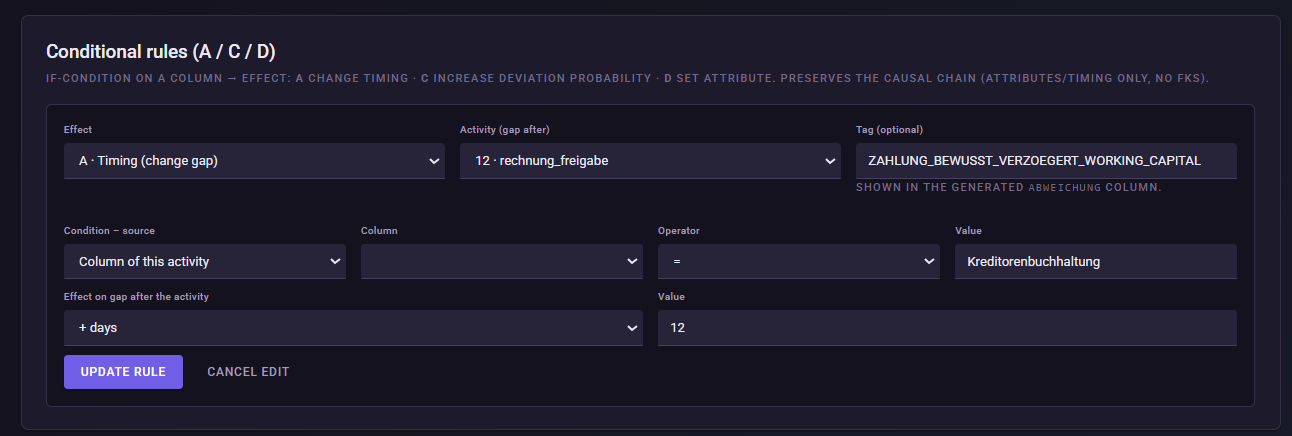
| Setting | Value |
|---|---|
| Effect | A · Timing (change gap) |
| Activity | rechnung |
| Condition source | Column of this activity |
| Column | pruefer_team |
| Operator | = |
| Value | Kreditorenbuchhaltung |
| Gap effect | + days |
| Value | 12 |
| Tag | ZAHLUNG_BEWUSST_VERZOEGERT_WORKING_CAPITAL |
What should I later see in Noreja?
Cases with:
pruefer_team = Kreditorenbuchhaltung
should exhibit a significantly longer cycle time between invoice and payment.
In addition, we can check:
Which payments lie after skonto_frist_am?
Which teams or process characteristics explain delayed payments?
How strongly do cases with and without a working-capital delay differ?
Later, the financial question can also be derived from this:
How much cash discount is lost through process delays?
With this, we connect a process cause with a possible financial effect for the first time.
Difference from poor supplier performance
Both use cases use a Conditional Rule, but pursue different business hypotheses.
Poor supplier performance
Lieferant
→ process takes longer.
Working Capital
internal checker team
→ payment is deliberately delayed
→ financial deadline can be exceeded.
This makes it visible that longer cycle times can arise from both external and internal causes.
Common mistakes / things to watch out for
Use + days and not × factor.
We want to add twelve days deliberately.
Do not shift skonto_frist_am along.
The deadline must stay fixed so that a delayed payment actually becomes recognizable.
Distinguish Simple and Expert.
In the Simple model we generate the delay and the cash-discount risk. The automatic calculation of the actual cash-discount loss follows later in the Expert part.
Result
With this, our Simple data set now contains all the intended synthetic use cases:
Maverick Buying
→ an intended approval path is bypassed.
Poor supplier performance
→ a supplier extends process times.
Order change / rework
→ an order is processed after the fact.
Wrong Order
→ order and approval lie in the wrong temporal sequence.
Open processes
→ cases deliberately end at various points in the process.
Working Capital / cash-discount risk
→ internal decisions delay the payment and can jeopardize financial deadlines.
With this, the Simple part of the demo training is complete.
Next step
Save this state as:
Config 2 – Simple
In the next section we switch to:
Mode: Expert
and extend the P2P model with different procurement paths, capacity bottlenecks, backlogs, delay propagation and the actual calculation of cash-discount losses.